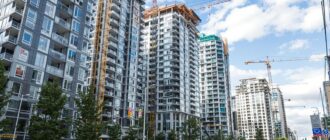

For the last couple of years, there’s been much agonizing over whether condos are encroaching too much on the downtown, the invasive species of the development world choking out commercial and industrial uses wherever they go.
This concern has become particularly acute in Vancouver, where the city’s aggressive densification policies have transformed entire neighborhoods. Areas that once housed light manufacturing, warehouses, and small businesses have been rezoned and redeveloped into gleaming residential towers. The transformation of False Creek, Yaletown, and Coal Harbour from industrial waterfront to luxury housing represents the most dramatic examples of this shift.
The economic forces driving this conversion are straightforward but relentless. Residential development, particularly luxury condominiums, generates significantly higher land values than industrial or commercial uses. A site that might house a small manufacturing operation employing dozens of people can be worth millions more if converted to residential towers. This creates an irresistible pressure for property owners to sell to developers and for cities to rezone land to capture higher property tax revenues.
The social and economic implications, however, are far more complex. When industrial sites disappear, they take with them not just jobs but entire economic ecosystems. Small manufacturers often support networks of suppliers, service providers, and skilled trades workers. Their displacement doesn’t just eliminate direct employment but can fragment entire industrial clusters that took decades to develop.
People often talk as though this is something unique to Vancouver, the product of its policy of promoting housing downtown. What is often missed is that this is a phenomenon going on in many globally attractive cities, as there’s a kind of reshuffling of uses going on.
Cities like London, San Francisco, Seattle, and Sydney are experiencing similar pressures. In London, traditional manufacturing areas in East London have been transformed into residential districts, pushing working-class communities and small businesses to the periphery. San Francisco’s South of Market area, once home to warehouses and light industry, now features some of the city’s most expensive condominiums.
This global pattern reflects broader economic trends that extend far beyond municipal planning policies. The financialization of real estate markets has turned housing into an investment commodity, driving up land values in desirable urban locations. Meanwhile, globalization has shifted much manufacturing to lower-cost jurisdictions, reducing demand for urban industrial space in wealthy countries.
The COVID-19 pandemic has accelerated these trends, as remote work has reduced demand for office space while increasing interest in urban residential living. Cities are now grappling with converting empty office towers into residential units, further intensifying the competition for urban space.
Of course, it’s a worrying one, since no one is enchanted by the idea of city centres turning into places that don’t have anything but service jobs for the ceremonial and residential users downtown.
The economic diversification that once characterized healthy urban centers is being replaced by a narrow focus on residential development and high-end services. This creates what economists call “monoculture” – cities that become overly dependent on a single economic function. When that function is primarily residential, supported by restaurants, retail, and personal services, the result can be economically fragile communities that lack the innovation and productivity that comes from diverse economic activity.
The employment implications are particularly concerning. Industrial and commercial uses typically provide jobs across a wide range of skill levels and educational backgrounds. Manufacturing, warehousing, and small business operations offer opportunities for workers without university degrees to earn middle-class wages. When these are replaced by residential developments, the remaining jobs are often either highly skilled professional positions or low-wage service work, contributing to growing income inequality.
Some cities are beginning to recognize these challenges and implement policies to preserve economic diversity. Vancouver has introduced industrial land protection measures, while cities like Boston and Seattle have created incentives for mixed-use developments that include job-creating uses alongside residential units.
But it’s not a Vancouver-only problem by any means as this story about the problems of New York shows.
New York’s experience demonstrates that even cities with strong economies and diverse job markets are vulnerable to these pressures. The conversion of industrial waterfront areas in Brooklyn and Queens into luxury housing has displaced long-established communities and businesses, raising questions about the sustainability of making cities primarily residential.