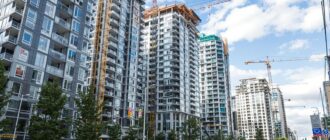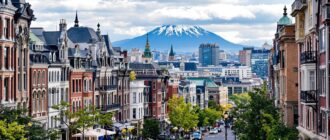

I have this story in today’s Globe and Mail about Tony Pappajohn, a local guy, who has been caught in the economic downdraft and credit squeeze. That’s put in jeopardy the beautifully designed new tower he was building on Hastings Street, a sad chapter for a family that’s part of the history of Vancouver.
The human cost of the 2008 financial crisis became starkly personal when Tony Pappajohn sat down with his construction crews this week to deliver devastating news: work on his ambitious 37-storey Jameson House tower would halt immediately. For a family whose immigrant story embodies Vancouver’s entrepreneurial spirit, the project’s collapse represents more than just another development casualty—it’s a profound disruption of a multi-generational dream.
Tony Pappajohn’s Greek immigrant parents spent half a century methodically building their modest empire of apartment and commercial buildings throughout Vancouver. Starting with nothing but determination, they accumulated properties one at a time, establishing the foundation for what would become Jameson Holdings. Their story mirrors countless immigrant families who saw real estate as both sanctuary and opportunity in their adopted city.
Working alongside his two brothers, Tony had successfully expanded the family business during the past decade, developing attractive small-scale apartment buildings in desirable Kitsilano and South Granville neighborhoods that sold and rented immediately. These projects demonstrated the family’s ability to read market demands and deliver quality housing that Vancouver’s growing population craved.
Five years ago, emboldened by their success, the Pappajohns decided to make their boldest move yet. They acquired prime downtown property and commissioned the prestigious Norman Foster architectural firm to design what would become Jameson House—a cutting-edge 144-unit glass tower featuring condos priced between $500,000 and $5.3 million. The project represented their family’s evolution from small-scale landlords to major players in Vancouver’s booming development scene.
The tower promised to be extraordinary: environmentally innovative architecture combined with the restoration of two heritage buildings next door. Despite its unconventional business district location rather than sought-after waterfront positioning, the project carried significant prestige, situated on the same block as two of Vancouver’s most exclusive private clubs. Marketing materials emphasized stylish Italian fittings and sophisticated urban living for discerning buyers.
By October, 105 of the 144 units had sold, with purchasers providing deposits ranging from 15 to 25 percent of their condo prices. Construction crews had just completed excavating a 21-meter foundation hole when the global financial crisis struck with devastating precision.
On October 28, one of Pappajohn’s three syndicated lenders—a major Canadian bank he declined to identify—abruptly withdrew from the $180-million project. The bank cited only “market conditions,” offering no criticism of the development’s viability or sales performance. Indeed, the presentation center continued attracting steady visitor traffic even as global markets collapsed.
For two desperate weeks, Pappajohn frantically sought replacement financing while construction costs continued accumulating. Facing the impossible choice between potentially defaulting on worker payments or halting a half-completed project, he chose the ethically responsible path. “I had to ask myself, ‘Is that fair to keep them working when you don’t know if you can pay the bills?'” he explained from his downtown office. “What if it doesn’t work out and I can’t get the financing and I can’t pay these people? They have families.”
Approximately 40 construction workers lost their jobs immediately, joining thousands across Vancouver’s development sector as the credit crisis cascaded through the real estate industry. Other major projects faced similar challenges: two Surrey developments halted, the Olympic athletes village struggled with cost overrun financing, and established developers like Concord Pacific, Westbank, and ParkLane postponed projects until market stability returned.
The situation left Pappajohn navigating complex obligations to multiple stakeholders. The 105 condo purchasers who had invested substantial deposits awaited news about their homes and money. Marketing partner Bob Rennie postponed decisions about buyer protection until financing prospects clarified. Construction contractors faced uncertain payment schedules for work already completed.
“It’s not a project failure,” Pappajohn insisted, his voice carrying the weight of professional pride and personal anguish. “It’s a market failure.” This distinction mattered profoundly to a family whose reputation had been built on delivering quality projects on time and budget.
The broader implications extended beyond individual hardship to Vancouver’s urban development trajectory. Projects like Jameson House represented the city’s evolution toward sophisticated, architecturally ambitious high-density living. The Norman Foster design brought international architectural prestige to Vancouver’s downtown core while demonstrating how heritage preservation could coexist with contemporary development.
Yet the crisis also exposed vulnerabilities in Vancouver’s development financing ecosystem. Projects dependent on syndicated lending faced existential risks when any single lender withdrew, regardless of overall project viability. The rapid market shift from abundant capital to credit drought caught many developers between signed construction contracts and evaporating financing commitments.
For the Pappajohn family, the potential solutions carried profound implications. Selling the partially completed project would provide immediate relief but surrender decades of relationship-building and market positioning. Finding alternative financing might save the development but require accepting onerous terms that could jeopardize future projects.
“Would I sell the project? In a heartbeat,” Pappajohn admitted with characteristic honesty. “I need to do what’s prudent for everybody. If I could pay everybody’s bills and be back to where I was five years ago, I’d have the world’s most expensive MBA and be happy.”
His search for “an angel” to help finish “a beautiful project” reflected both pragmatic desperation and genuine belief in Jameson House’s architectural and urban value. The tower represented not just family ambition but contribution to Vancouver’s metropolitan sophistication.
As 2008 drew to a close, analysts predicted months of market instability before recovery—an eternity for developers holding expensive land and outstanding construction loans. The Pappajohn story illuminated how quickly global economic forces could overwhelm local success, transforming immigrant achievement narratives into cautionary tales about the precarious nature of real estate development in modern capitalism.